CURRENTLY READING: IN THE FLOW
On aesthetic self-consciousness: ‘Artistic, poetic, rhetorical practice is none other than self-presentation to the gaze of the other, which presupposes danger, conflict and risk of failure’ (p. 128).

On aesthetic self-consciousness: ‘Artistic, poetic, rhetorical practice is none other than self-presentation to the gaze of the other, which presupposes danger, conflict and risk of failure’ (p. 128).

Earlier this week I had the pleasure of moderating a panel discussion with this year’s KARA (Kooshk Artist Residency Award) recipients: Haffendi Anuar (Malaysia), Laure Catugier (France), Rafael Cañete Fernandez (Spain), and Sarah Feuillas (France) at Darbast Platform in Tehran, Iran.

I will be joined by co-curator Tooraj Khamenehzadeh and artist, curator, and lecturer Behrang Samadzadegan for a panel discussion about our exhibition Haft Paykar | Seven Beauties (on view at Mohsen Gallery through June 7, 2019):
Tuesday, May 21 at Darbast Platform at Mohsen Gallery, 7pm.

Haft Paykar | Seven Beauties is a group exhibition I curated with Tooraj Khamenehzadeh. It opens on Friday, May 17 at Mohsen Gallery in Tehran, Iran, and runs through June 7, 2019. Participating artists include Cui Fei, Naiza Khan, Anna Khodorkovskaya, Neža Knez, Nicène Kossentini, Negin Mahzoun, and Nina Papaconstantinou.

‘Even the farthest seers can’t bend their gaze beyond their era’s horizon of possibility, but the horizon shifts with each incremental revolution as the human mind peers outward to take in nature, then turns inward to question its own givens. We sieve the world through the mesh of these certitudes, tautened by nature and culture, but every once in a while—whether by accident or conscious effort—the wire loosens and the kernel of a revolution slips through’ (p. 8).

‘Writing exists (for me) at the intersection of three precarious, uncertain elements: language, the world, the self. The first is never wholly mine; the second I can only ever know in a partial sense; the third is a malleable and improvised response to the previous two’ (from the Foreword).

‘It has been partly such play with scale that has drawn my attention to the intervals between events, to what is happening when “nothing” is happening. The meaning of two hands clapped is fixed in the soundless interval between the claps. Just so, the meaning of our experience is held in the infinitely short intervals between our sensory perceptions’ (p. 15).

‘There is a mobile dynamics involved in the act of viewing films, even if the spectator is seemingly static. The (im)mobile spectator moves across an imaginary path, traversing multiple sites and times. Her fictional navigation connects distant moments and far-apart places. Film inherits the possibility of such a spectatorial voyage from the architectural field, for the person who wanders through a building or a site also absorbs and connects visual spaces. In this sense, the consumer of architectural (viewing) space is the prototype of the film spectator’ (pp. 55-56).

‘Once each of the unremarkable acts we undertake in the course of the day—opening the front door, buying the groceries, hopping onto the bus—has been reconceived as a digital transaction, it tends to dematerialize. The separate, dedicated chunks of matter we needed to use in order to accomplish these ends, the house keys and banknotes and bus tokens, are replaced by an invisible modulation of radio waves. And as the infrastructure that receives those waves and translates them into action is built into the ordinary objects and surfaces all around us, the entire interaction tends to disappear from sight, and consequently from thought’ (pp. 10-11).
‘Without attention, information means very little. The insight that attention, not information, is the prize in the struggle for power is not new. Almost two thousand years ago, the Roman satirical poet Juvenal wrote about how people’s demands for representation could be diluted by “panem et circenses” (bread and circuses), that is, by providing distracting entertainment while also making sure that they were fed. In the twenty-first century, the same dynamics hold, but this time, the circus is online’ (pp. 237-238).

‘In an ideal intellectual exchange, disagreement doesn’t mean tearing down a rival but testing and strengthening the structure of a proposal, an analysis. It is what you do when you agree with people in general but have specifics to work out; and that work can be a joy. It’s anti-evangelical work you go into with an open mind, as willing to be convinced as you are eager to convince. For those inclined that way, this exploration of ideas is an adventure full of the subtle pleasures of expanding meaning and understanding, of going beyond where one started. An idea goes back and forth like a tennis ball, but one that grows and changes with every volley. It’s an arrangement in which no one is the preacher or the choir, in which everything is open to question, in which ideas are beautiful and precision is holy’ (pp. 77-78, ‘Preaching to the Choir,’ 2017).
‘The communications industry would not have got where it is today had it not started out as an art of the motor capable of orchestrating the perpetual shift of appearances’ (p. 23).

‘Social media is conducive to the flow of artlessly formed chatter because it encourages real-time exchange and rewards charm, humor, and fearlessness, traits that the socially shy long to possess. Mistakes can and are frequently made within this space of cursory social engagement, but the socially courageous respond effortlessly: like falling awkwardly in public, the socially timid retreat ever further into their shells after a social blunder’ (Interações: Sociedade e as Novas Modernidades, Issue 34: (In)Equalities and Social (In)Visibilities in the Digital Age, p. 108).

‘When computers were vast systems of transistors and valves which needed to be coaxed into action, it was women who turned them on. They have not made some trifling contribution to an otherwise man-made tale: when computers became the miniaturized circuits of silicon chips, it was women who assembled them… Hardware, software, wetware—before their beginnings and beyond their ends, women have been the simulators, assemblers, and programmers of the digital machines’ (p. 37).
I’m very excited to accept an invitation to serve on the jury for this artist residency award in Tehran next May. The application deadline is October 31, 2018.

‘In a word, its surface is elastic, and its densities are scandalously rearrangeable… [A] soft sculpture, in various proportions, might suggest fatigue, deterioration or inertia. It mimes a kind of surrender to the natural condition which pulls bodies down. No matter how figurative, then, sculpture in general must be seen as, in an important sense, escaping the anthropomorphic. And regardless of how abstract is a soft sculpture, it will unavoidably evoke the human.’

'This book is about how to be a cat. How can you remain autonomous in a world where you are under constant surveillance and are constantly prodded by algorithms run by some of the richest corporations in history, which have no way of making money except by being paid to manipulate your behavior? How can you be a cat, despite that?' (p. 2).
'He is troubled by any image of himself, suffers when he is named. He finds the perfection of a human relationship in this vacancy of the image: to abolish—in oneself, between oneself and others—adjectives; a relationship which adjectivizes is on the side of the image, on the side of domination, of death' (p. 43).
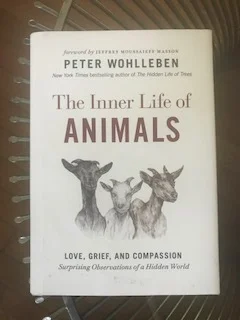
'Shy birds are slower and calmer, and take their time before mobilizing. And this means they notice things their courageous, speedy colleagues often overlook, such as seeds left over from the previous summer. Because the advantages and disadvantages to being either courageous or shy seem to balance out, both character traits have survived until today' (p. 65).

'Life is constitutively semiotic... Semiosis (the creation and interpretation of signs) permeates and constitutes the living world, and it is through our partially shared semiotic propensities that multi-species relations are possible, and also analytically comprehensible' (p. 9).